

Each turn has six phases. Understanding Priority (who has the right to act) is essential.
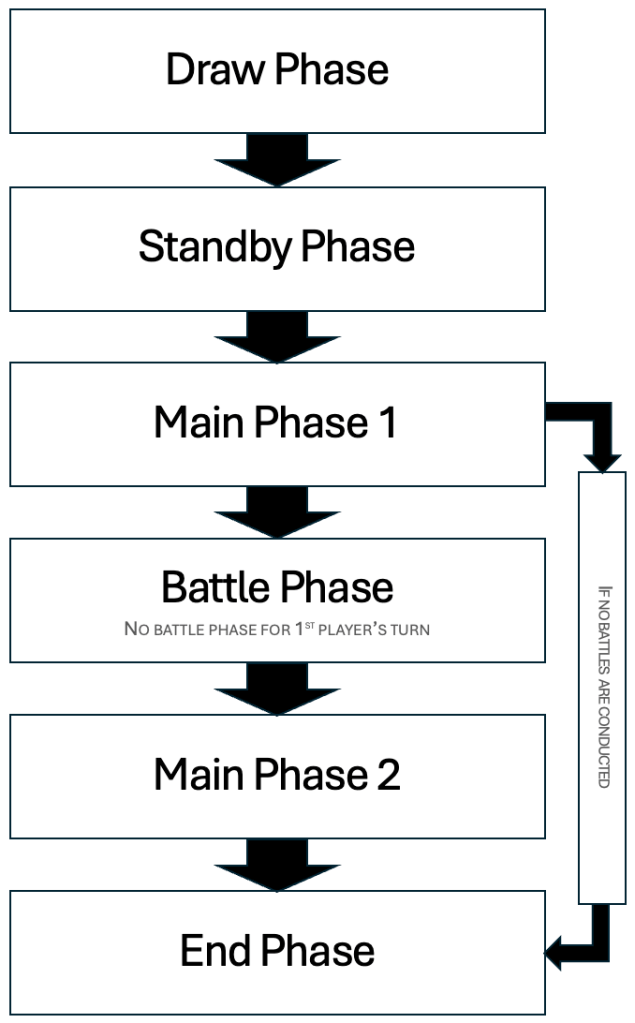
1) Draw Phase
- Action: Turn player draws one card.
- Only fast effects (Spell Speed 2 or higher) can be activated here. You can activate effects like Mulcharmy Fuwalos or Dimension Shifter, forcing the opponent to play their entire turn under a restriction.
2) Standby Phase
- Action: Maintenance costs and specific effects resolve (if applicable).
- Like in the Draw Phase, only fast effects (Spell Speed 2 or higher) can be activated here. You can activate effects like Mulcharmy Fuwalos or Dimension Shifter, forcing the opponent to play their entire turn under a restriction.
3) Main Phase 1
- Action: Normal Summon, Special Summon, activate Spells/Traps/Effects.

- Modern Strategy:
- Baiting: Activate less important cards first to tempt your opponent into using their negates. Save your “Starter” for when their board is exhausted.
- Reading: If the game pauses (in a simulator) or your opponent checks their hand/facedown cards after you summon, they likely have a response window. Use this information to deduce what card they have.
4) Battle Phase
The Turn Player can declare attacks with Attack Position monsters. The player going first does not have a battle phase on their first turn. Each Attack Position monster can declare one attack per turn unless specifically stipulated on the card. Monsters attack one at a time. If there are monsters on the opponent’s field, the turn player can choose one of their Attack Position monsters to attack an opponent’s monster. Each monster declares an attack one at a time. Once one battle step is completed, another monster can then attack. If there are no monsters on the opponent’s field, the turn player can attack the opponent’s life points directly. The opponent cannot attack.
Battle Positions:
- Attack Position: Monsters can attack. Damage is calculated using ATK.
- Defense Position: Monsters cannot attack. Damage is calculated using DEF.
Damage Calculation:
- Attack position monster vs. Attack position monster:
- Win: Monster with lower ATK is destroyed. Its controller takes damage equal to the difference.
- Tie: Both monsters are destroyed. No damage.
- Attack Position Monster vs. Defense Position Monster:
- ATK > DEF: The Defense Position monster is destroyed. No damage is inflicted (unless Piercing applies).
- ATK = DEF: Neither monster is destroyed. No damage.
- ATK < DEF: Neither monster is destroyed. The attacker takes damage equal to the difference.
- Direct Attack: If the opponent controls no monsters, you can attack directly. The opponent takes damage equal to the monster’s ATK.
| Sequence | What Happens | Key Phrases that can Happen Now |
|---|---|---|
| Start of the Damage Step | * You declare that you are entering the Damage Step. | * effects that activate “at the start of the damage step” |
| Before Damage Calculation | * If the monster being attacked is face-down, flip it face-up. Then, cards or effects that modify ATK/DEF can activate. If the monster has a Trigger Effect that activates by being flipped face-up, it does not activate yet. | * effects that activate “before damage calculation” |
| Perform Damage Calculation | * Cards or effects that can activate “during damage calculation” activate/resolve, then the damage calculation is performed. * Compare ATK/DEF and apply damage to Life Points.* Determine whether either monster will be destroyed by battle or not, but do not send it to the Graveyard yet. | * effects that activate “during damage calculation” |
| After Damage Calculation | * Effects that activate as a result of battle happen here .* Trigger effects that activate by being flipped face-up, of monsters flipped face-up “before damage calculation,” happen here. * A monster that was determined to be destroyed is still not sent to the Graveyard. | * effects that activate “when this card battles” or “attacks or is attacked” * effects that acitvate “when battle damage is inflicted” or “when you take damage” * effects that activate “after damage calculation”* FLIP: effects* effects that activate “when this card is flipped face-up” |
| End of the Damage Step | * If a monster was determined to be destroyed by the battle during damage calculation, send it to the Graveyard first. * Then effects that activate when a monster is destroyed by battle and sent to the Graveyard, activate now. * Then if all effects activates/resolves and you would end the Damage Step, effects that apply “until the end of the Damage Step” disappear * After the end of the Damage Step, return to the Battle Step. If the turn player does not want to attack again after that, go to the End Step. | * effects that activate “when a monster is destroyed by battle” * effects that activate “when a monster is destroyed by battle and sent to the Graveyard” * effects that activate “when a monster destroys an opponent’s monster by battle and sends it to the Graveyard”* effects that activate “at the end of the Damage Step” |
Special Mechanics:
- Piercing Damage: Certain effects allow a monster to inflict Battle Damage even when attacking a Defense Position monster. The damage equals ATK minus DEF.
- Replay: If the number of monsters on the opponent’s field changes during the Battle Step (e.g., they activate a Trap to summon a monster), a “Replay” occurs. You can choose to attack with the same monster again (selecting a new target), or cancel the attack.
Steps: Start Step -> Battle Step -> Damage Step -> End Step.
5) Main Phase 2
- Action: Same as Main Phase 1
6) End Phase
- Actions: Temporary effects expire. Discard to hand limit (6) at the end of your turn. Activate any mandatory effects
- Modern Strategy: Some decks search cards in the End Phase to prepare for the next turn.
 60 Card Slop
Leave a comment